
2025–2026
Tech4Me: helping Ohioans with disabilities find the technology that works for them
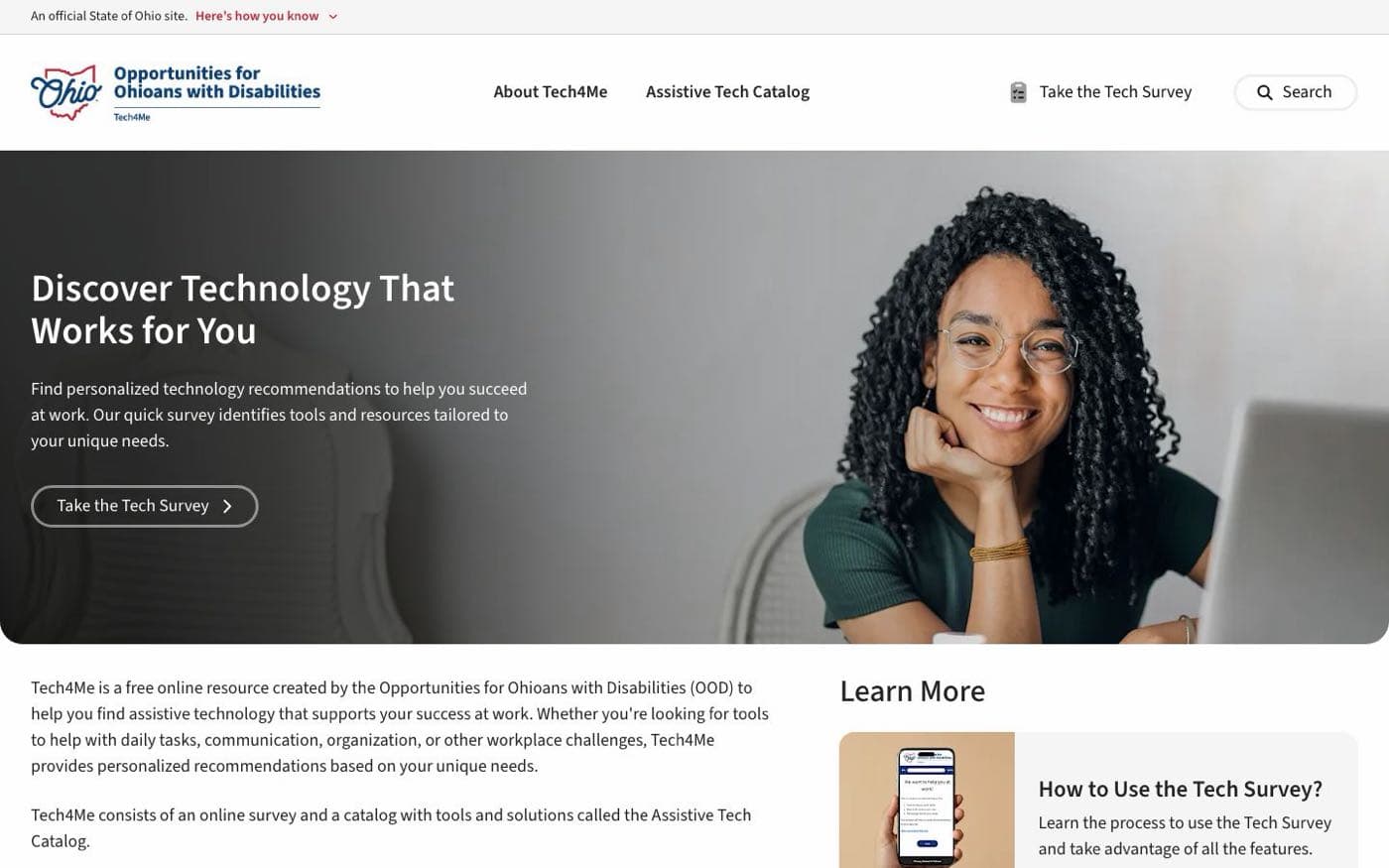
For an Ohioan with a disability, the right technology, from a screen reader to audio directions to the bus stop, can be what makes a job possible. Tech4Me is where they, their families and their counselors find it. We redesigned that journey with the people who take it: the questionnaire went from 45–60 minutes to 5–10, in plain language, and ends in a personal report that links every recommendation to the tools themselves.
- 5–10
- minutes to complete, down from 45–60
- 11
- questions, down from 74
- 3rd–6th
- grade reading level, in plain language
- AAA
- WCAG 2.1 conformance
- Client
- Opportunities for Ohioans with Disabilities
- Industry
- Public sector
- Scope
- User journey redesign · UX research · Content design · Accessibility · Usability testing
- Platform
- Contentful + Next.js + SurveyJS
- Partnership
- 2025–2026
Challenge
One of the stories on Tech4Me follows Jamie, who wants to take the bus to work on their own. With the Wayfinder app on their iPhone, Jamie’s team photographed every landmark on the walk to the stop and recorded each step of the route in Jamie’s own voice. That is what the right technology does: it turns a goal into something a person can do independently.
Opportunities for Ohioans with Disabilities (OOD) helps people find that technology, with Ohio State’s Nisonger Center and the Ohio Department of Developmental Disabilities (DODD), and Tech4Me is where the journey starts. Before the redesign, its questionnaire asked 74 questions and took 45–60 minutes. For people with disabilities, and the family members, caretakers and counselors who help them, that hour stood between them and the support at the end of it.
Many people take it with someone beside them: support staff, a supervisor, a co-worker or another person they trust. OOD needed a journey anyone could finish, on their own or with help, including people who use a screen reader or navigate by keyboard, and results they could take to the people who support them.
Approach
We started with the people
We ran research with Ohioans with disabilities and with vocational rehabilitation providers: one-to-one sessions, including screen-reader and keyboard-only testing, and card sorting to organize the site the way people look for help.
Ten minutes instead of an hour
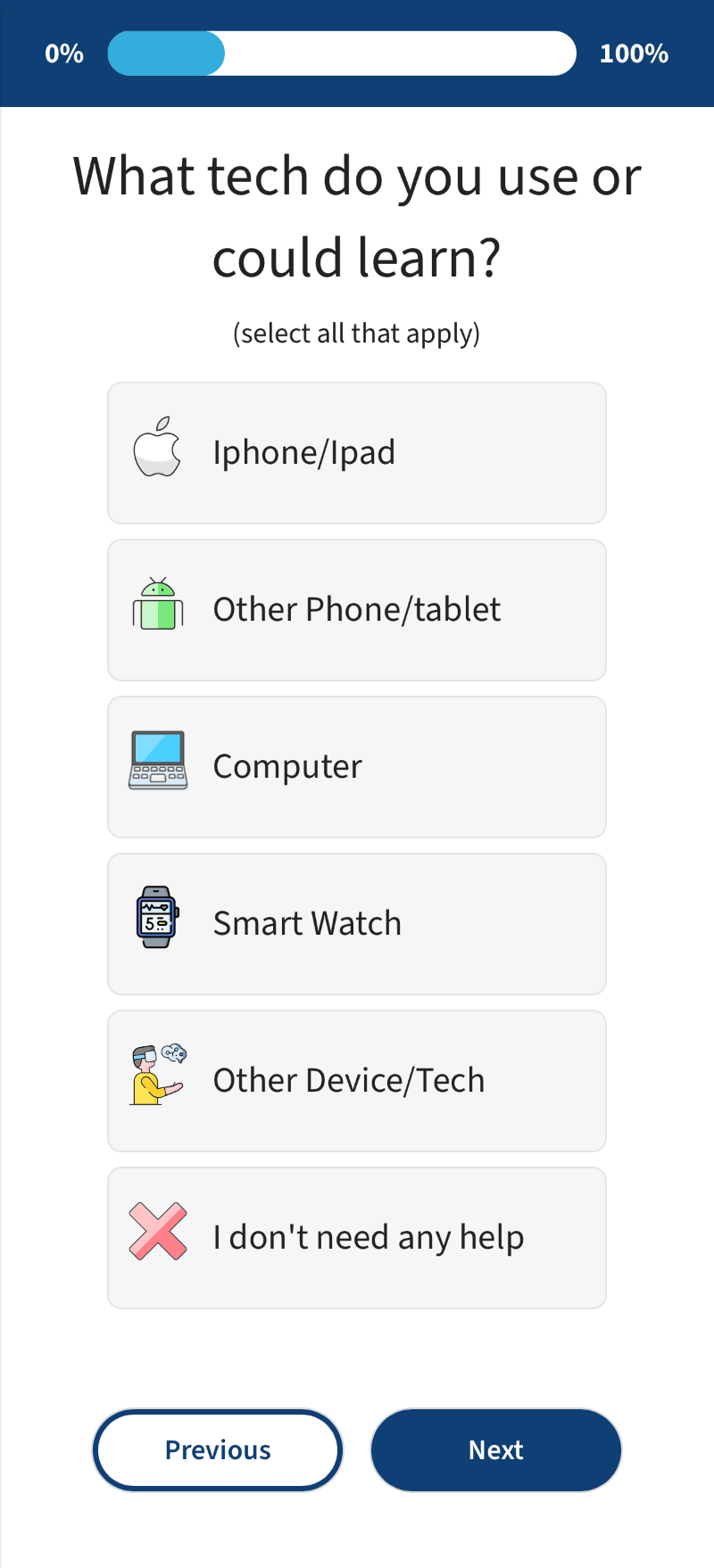
We redesigned the questionnaire question by question. 74 questions became 11, rewritten in plain language at a 3rd–6th-grade reading level. It asks one question per screen, with a progress bar, a picture beside every answer, large touch targets and room for people who are already set: “I don’t need any help.”
A report people can act on
The questionnaire ends in a personal report, grouped by each person’s support needs, with links to the suggested tools in the Assistive Tech Catalog. People can keep it without an account, as a link, a PDF, a printout or an email, and bring it to their support team and their counselor to decide together which tools to try.
Tools organized around a working day
The toolkit used to be a static PDF. We turned it into about 120 pages of plain-language content, and the catalog follows the moments of a person’s day rather than device types: starting my day, getting to work, doing my job, working with people, handling challenges and growing at work. The Tech4Me Lifecycle explains what comes after the report, from getting the technology to using it, adjusting it as work and life change, and finding support, and real-life examples show the tools in use.
Technology chosen for the people, and the State
The State expected a subscription form tool such as Typeform or JotForm. We evaluated them and chose SurveyJS instead, and built the survey as components for the State’s InnovateOhio Platform. That kept the branching, the scoring and the accessibility of every screen in our hands, and it keeps every answer in OOD’s own environment rather than a third party’s. The site runs on Contentful and Next.js, the State’s new web platform, with a content model we designed so OOD’s team can keep adding tools and stories. It meets WCAG 2.1 AAA, the highest conformance level, and went live in April–May 2026.
Impact
Since May 2026, an Ohioan with a disability, on their own or with a family member, caretaker or counselor, finishes the questionnaire in 5–10 minutes instead of 45–60, reads every question in plain language, and leaves with a report that links each need to tools they can look up and discuss with their team, on a site that meets WCAG 2.1 AAA.
We won the project in competition with the four other contractors pre-qualified on the State’s platform, and delivered all 16 of its deliverables within the contract term. The work took 1st place in the Research for Social Good category at the 2026 Optimal Experience Awards, a result we share with OOD, Ohio State’s Nisonger Center and DODD.
It is what accessibility looks like when it starts with the people rather than an audit: the plain language, the one-question screens and the AAA build all came out of sessions with the people who use the site.